
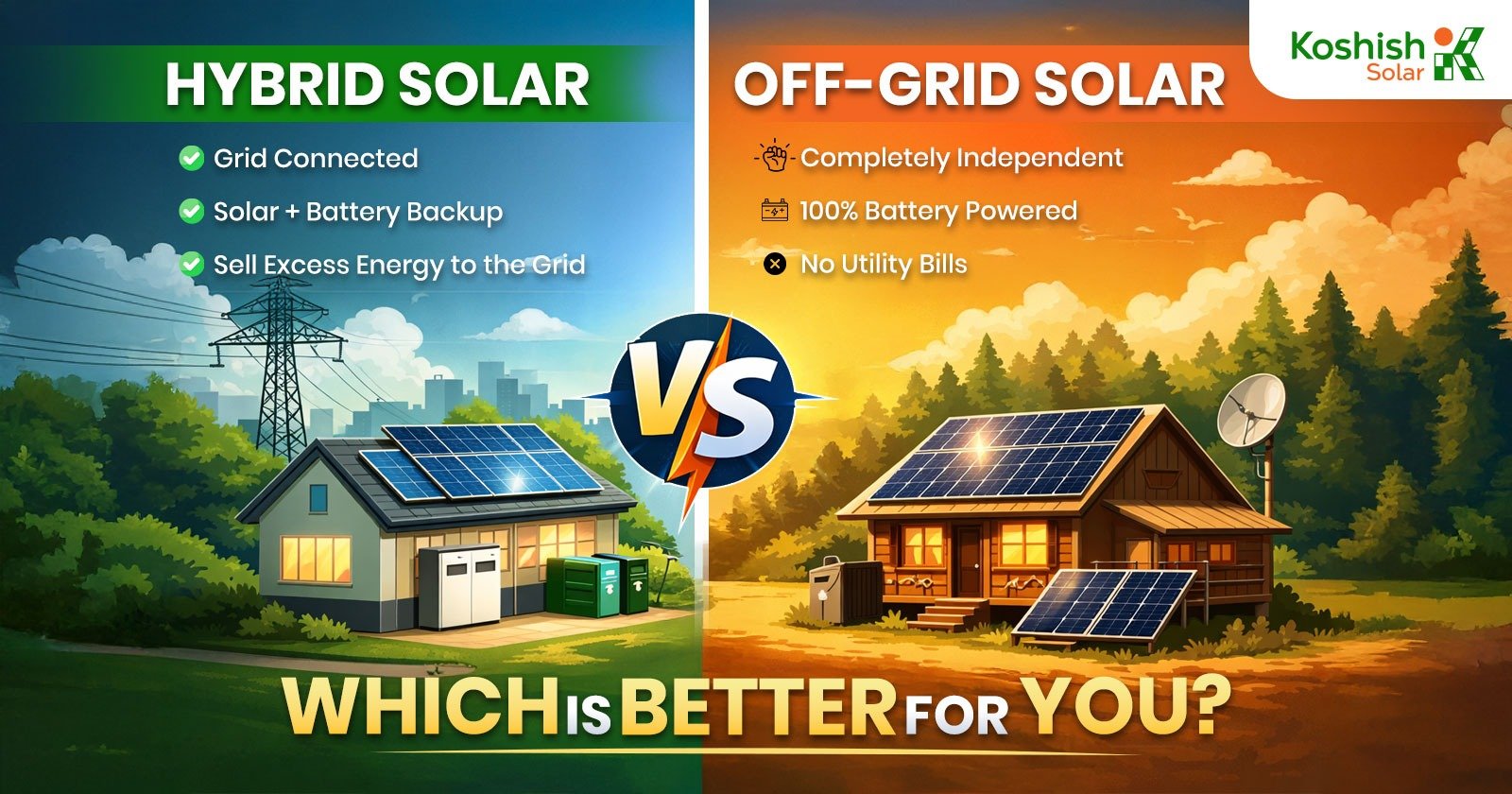
Solar energy is becoming more popular because people look for cleaner and cheaper ways to power their homes and businesses. But when it comes to choosing a solar system, you may be confused, like Should I go with a hybrid system or an off-grid system?
Both solar systems use sunlight to generate electricity, but they work in different ways. A hybrid solar system is connected to the electricity grid and uses batteries, while an off-grid system works completely independently without any connection to the grid.
In this blog, we’ll explain what each system does, the key difference between Hybrid Solar vs. Off-Grid Solar, and which one might be perfect for you. Whether you live in metropolitan cities, small towns, or remote areas.
What is a Hybrid Solar System?
A hybrid solar system is a combination of on-grid and off-grid solar systems. It uses solar battery storage, a hybrid inverter, and solar panels to generate and store the energy. It converts sunrays into DC electricity. A hybrid system helps to reduce the electricity costs.
What Is an Off-Grid Solar System?
An off-grid solar system supplies electricity independently from the local utility grid. It generates electricity from the rays and stores it in off-grid solar battery storage. It supplies electricity from the off-grid solar battery storage when needed. This is a perfect option for those who live in remote locations or are looking for an independent energy source.
Key Differences Between Hybrid Solar vs. Off-Grid Solar
Both systems generate electricity from the sun but work differently. Look at the table below and identify the key differences between a Hybrid Solar vs. Off-Grid Solar system.
| Key Differences Between Hybrid Solar vs. Off-Grid Solar | ||
| Feature | Hybrid Solar | Off-Grid |
| Connection | It is connected to the power grid. | No grid connection needed. |
| Power Backup | It feeds extra energy into off-grid solar battery storage and uses the grid when needed. | Supply power from the off-grid solar battery storage. |
| Energy Usage | It uses a solar panel, a grid, and a power battery. | It uses only a battery and a solar panel. |
| Electricity Supply | More stable. | Less stable if the battery runs out. |
| Installation Costs | More expensive | Less expensive |
| Perfect For | Businesses and homes | Remote locations |
Advantages of an Off-Grid Solar System
There are more advantages of an off-grid solar system; let’s discuss them in the points below.
- It is an ideal option for remote locations. It supplies energy independently from the local utility grid.
- It is 100 % carbon-free. You can easily install it at your home.
- Off-grid is a self-sustaining solar power system.
- However, in initial installation may be costly, but it will help you reduce your electricity bills.
- With off-grid solar battery storage, you can store excess solar energy and use it anytime, even during nights or cloudy days.
- It works without the DND application.
Hybrid PV System Advantages
A hybrid photovoltaic (PV) system connects solar panels to other renewable sources such as wind. Let’s examine the hybrid PV system advantages.
- A hybrid solar system supplies electricity continuously.
- Solar systems are cost-effective in the long run, however, installation costs may be high.
- Hybrid PV system advantages It reduces the carbon footprint and saves the environment.
- During electricity outages, it will automatically switch to battery storage to continue the electricity supply.
Which One Suits Your Energy Needs?
The type of solar panel depends on various factors such as budget, location, needs, consumption level, and other factors.
- Energy Needs: Analyze your daily electricity consumption limit. If your budget is high, you can install a hybrid solar system. If you face 7-15 hours of electricity outages or live in remote areas, you should go with an off-grid solar system, which is an independent energy solution.
- Location: It depends on your location; if you live in remote areas, you should choose an off-grid system, which stores energy in an off-grid solar battery storage system. Otherwise, if you live in metropolitan cities or experience power outages 1-2 hours daily, you can install a hybrid solar system.
- Budget : Analysis factors such as installation cost, savings on electricity bills, and maintenance charges, etc. However, on-grid set-up cost is budget-friendly, while the hybrid solar system may be costly.
- Sustainability Goals : If you compare differences between hybrid solar vs. off-grid solar for sustainable goals, an off-grid system may be the best option for you. It supplies 100% carbon-free energy.
How Hybrid Solar Provides Backup Power Without a Full Off-Grid Setup?
Without setting up the full off-grid setup, a hybrid solar system stores the energy in the battery and provides electricity.
Here’s how Hybrid Solar provides backup power without a full Off-Grid setup.
- Solar Energy Generation: Solar panels capture rays and transform them into electricity, which is used for immediate or stored in batteries.
- Battery Storage: It feeds excess energy into battery storage that can be used on cloudy days or at night.
- Grid Connection: If the batteries drain and there’s not enough sunlight, the system uses grid power to supply energy.
- Hybrid Inverter: It is an essential part of a hybrid solar system; it manages electricity flow between the solar panel, battery, and grid.
- Backup Power: During outages, it switches automatically to battery storage and supplies energy.
Which is Better, a Grid-Tie or off-grid Solar System?
If we compare Grid-tied solar to off-grid solar, it depends on individual needs and energy consumption level. Selecting between a grid-tied or off-grid solar system depends on your needs and location.
Grid-tied systems are cheaper and easier to install if you have a reliable electricity connection. They also allow you to earn from extra energy through net metering, according to Tata Power.
Off-grid systems provide you with full energy independence and best option for remote areas, but they cost more upfront and need regular battery maintenance. In a simple Grid-tied solar comparison, these systems are better for places with steady grid electricity, while off-grid systems are best for remote areas.
Which Solar System is Right for You: Hybrid or off-Grid?
Which solar system you should install depends on your needs and location. If you live in a remote location or there is no source of energy, you should install an off-grid solar system. Off-grid solar generates electricity independently.
If you live in areas where you face no electricity outage problems, you can choose a hybrid solar system. A hybrid solar system may be costly, but it can reduce your electricity costs.
Hybrid Solar vs. Off-Grid Solar Installation & Maintenance Costs: Which Option is More Affordable?
The hybrid solar system installation & maintenance cost is more than an off-grid solar system. Hybrid solar installation is expensive due to setting up batteries and connecting to the grid.
Off-grid systems work without any grid connection, so their setup is simpler and can be more affordable. But they also need batteries to store excess energy for later use, which can affect the total cost.
Hybrid solar systems initial cost may be high, but they give you the benefit in the long run, making your power supply more reliable. An off-grid solar system is an independent energy source, especially in remote areas.
Wrapping Up
Choosing the right solar system, Hybrid Solar vs. Off-Grid Solar, depends on your energy needs, location, and goals. Each system has its own advantages, and the best one for you depends on your situation. At Koshish Sustainable Solutions Pvt.Ltd, we install solar panels for homes, businesses, industries, and large utility projects. Contact us today to find the right solar solution for you and step towards clean and reliable energy!